
Congenital Umbilical Appendix Misdiagnosed as Umbilical Granuloma: Report of 2 Cases
Abstract
Background: Umbilical cord hernia is an uncommon umbilical anomaly which develops during 10th to 12th weeks of gestational age owing to failure of complete bowel return into coelomic cavity. In extremely rare cases appendix is the only trapped organ in hernia sac which may erode the overlying membrane and simulate umbili-cal granuloma.
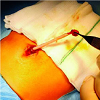
Case Report: Two infants presented with delayed umbilical cord separation with a reddish mass at umbilicus which was initially diagnosed as umbilical granuloma. Surgical exploration on failure of conservative measures revealed it as vermiform appendix. Appendectomy was done in both cases.
Conclusion: Vermiform appendix at umbilicus is a rare congenital anomaly and may simulate other pathologies at umbilicus.
Downloads
References
Mirza B, Mirza A, Hashim I, Saleem M. Hernia of umbilical cord: report of three unusual cases. J Neonatal Surg. 2015; 4:16.
Hasaniya NW, Premaratne S, Varnes PM, Shin D, Shim W. Hernia into the umbilical cord with incarceration of liver and gall bladder in a newborn. J Pediatr Surg Case Rep. 2013; 1:432-3.
Pal K. Congenital hernia of the umbilical cord associated with extracelomic colonic atresia and perforation of gut in a newborn. Afr J Paediatr Surg. 2014; 11:74-6.
Fuijkschot J, Wijnen RM, Gerrits GP, Dubois SV, Rieu PN. A neonate with an intact congenital umbilical appendix: an alternative theory on the etiology of the appendico-umbilical fistula. Pediatr Surg Int. 2006; 22:689-93.
Choi SO, Eunyoung Jung, and Woo-Hyun Park. Umbilical cord hernia containing vermiform appendix adherent to the sac. J Korean Surg Soc. 2011; 80:161-3.
Salah SDG, Almushly RMA, Eltayeb K, Elgaili E. Congenital umbilical appendix. Sudan Med J. 2009; 45.70-4.
Copyright (c) 2018 Javad Ghoroubi, Leily Mohajerzadeh, Saran Lotfollahzadeh, Khashayar Atqiaee

This work is licensed under a Creative Commons Attribution-NonCommercial-ShareAlike 4.0 International License.
This publication
- Authors retain copyright and grant the journal right of first publication with the work simultaneously licensed under a Creative Commons Attribution, Non commercial, Share alike License 4.0 that allows others to share the work with an acknowledgement of the work's authorship and journal.
- Authors are permitted and encouraged to post their work online (e.g., in institutional repositories or on their website) after publication as it can lead to productive exchanges, as well as earlier and greater citation of published work (See The Effect of Open Access).
- Authors also confirmed that they have taken permission/consent for publication of this manuscript and of copyrighted material (if it is used in the manuscript).


